
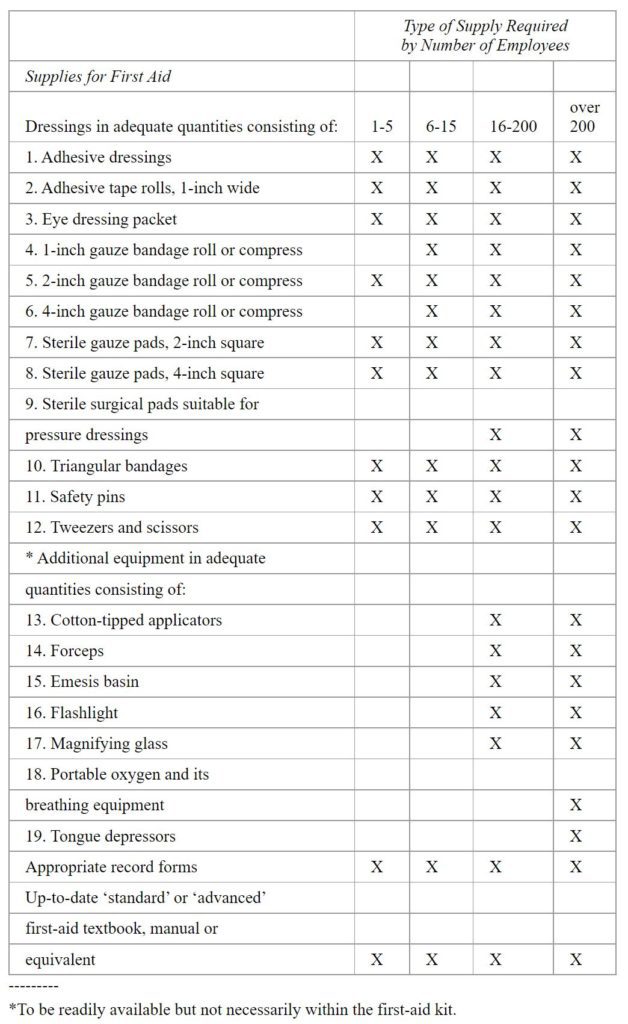
California has specific requirements for contractor first aid kits under Title 8, Section 1512 of the Construction Safety Orders. These rules apply to construction projects, line crews, and other temporary or mobile job sites where employers are required to keep first aid supplies available.
The regulation includes a minimum list of supplies and requires the kit to be stored in a weatherproof container. It also states that first aid supplies must be approved by an employer-authorized or licensed physician.
This is the part many employers miss.
When you purchase a standard Cal/OSHA contractor first aid kit, it does not come with a signed physician approval. The employer is responsible for having the kit reviewed based on the actual jobsite, hazards, crew size, and distance from emergency medical care.
You can review the full Cal/OSHA requirements and supply table directly on the official Cal/OSHA website and in the table below.
What Does This Mean for Employers?
In simple terms, the standard Cal/OSHA contractor kit is considered the minimum starting point for compliance. The supply list is fairly limited and may not fully address the types of injuries that can happen on real-world job sites.
Some crews work close to emergency services while others may be working in remote areas where response times are longer. Hazards can also vary significantly depending on the work being performed.
That is why physician review is required. The physician can approve the kit as-is or recommend additional supplies based on the workplace and jobsite risks.
Where Do You Get a Physician Approval?
We spoke with a Cal/OSHA representative at the NCS Safety Congress to better understand how employers typically handle this requirement.
According to Cal/OSHA, many employers work with the same occupational health clinic or medical provider they already use for workplace injuries. In many cases, employers can simply send the kit contents list to the physician for review.
The physician may approve the kit or recommend additional supplies based on the work environment and expected injury risks.
Employers are also responsible for regularly inspecting their kits and replacing used, missing, or expired supplies.
It is important to note that the physician will help you determine supplies that may be needed based on your individual occupation and hazards, but it will remain the employer’s responsibility to keep the supplies inspected regularly to ensure that the expended and expired items are promptly replaced.
Looking Beyond Minimum Compliance
The Cal/OSHA contractor kits are generally considered the minimum baseline for compliance. Many employers choose to move into ANSI Class A or Class B first aid kits instead of relying only on the standard contractor supply list.
Class A kits are usually a better fit for general workplace use and lower-risk job sites because they include a more practical assortment of supplies.
For construction, industrial work, remote crews, or environments where more serious injuries may occur, Class B kits are often the better option due to the larger quantities and broader assortment of supplies.
Many employers use Cal/OSHA contractor kits to satisfy baseline requirements while relying on ANSI kits as their primary first aid setup.
Choosing the Right Kit
Every workplace is different. Crew size, jobsite hazards, travel time to emergency care, and work environment all play a role in determining the right level of first aid preparedness.
If you need help selecting a Cal/OSHA contractor kit, ANSI Class A kit, ANSI Class B kit, or a custom setup for your workplace, our team can help.
Related First Aid Kits
- View CAL/OSHA Contractor Kits
- Shop ANSI Class A Kits
- Shop ANSI Class B Kits